
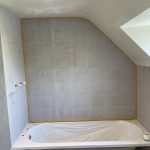
Grout Lines Visible in Microcement Finish
This guide explores some of the reasons which might explain why grout lines are visible in the final finish and explains the best way to resolve the problem.
What Causes Grout Lines to Be Visible in the Final Finish?
There are two reasons why grout lines may remain visible after the microcement coats have been applied. Each reason is explained in detail below:
- Moisture in the Grout Lines or Filler
We always recommend that surfaces are completely clean and dry before applying microcement.
Because grout lines are generally very thin, moisture within them can be difficult to notice. Furthermore, because tiles are often installed in wet areas, they are susceptible to deep moisture saturation within the grout, which can take a long time to dry out.
If microcement is applied while moisture is still present in the grout lines, that moisture will become trapped under the surface. This can cause the microcement to discolour along the grout lines, leaving a visible trace on the finished surface.
The outcome will be the same if moisture is trapped within the filler used to flush out the grout lines.
- Insufficient Filler in the Grout Lines
We also recommend that surfaces are completely flat before microcement is applied.
If you do not use enough filler to flush out the grout lines, or if the filler sinks into the lines after application, a small indentation will form along the grout network. In this case, you will be able to physically feel the indentation on the surface.
Preventative Steps
Check the Moisture Content of Grout Lines
It is good practice to check grout lines with a moisture meter before applying filler, and again before applying the primer and microcement.
If you do not have a moisture meter, allow the grout lines plenty of time to dry out naturally before starting the application.
ImpriPox Primer
You can apply Impripox primer over the tiles to help to block moisture from transferring through to the microcement. This acts as a vapour barrier, preventing moisture (with a maximum moisture content of 10%) from transferring through to the microcement.
Once the impripox is dry, you will need to apply Primer 100 over the Impripox to ensure good adhesion.
Ensure Surfaces Are Completely Flat Before Applying Microcement
Surfaces must be completely flat before microcement application begins. Because the finished microcement layer is only 3–4mm thick, subfloor or wall preparation needs to be as flawless as if the surface were being prepared for paint.
How to Resolve
How Can I Block Moisture in Grout After Applying Microcement?
If you are installing microcement over tiles and notice discolouration along the grout lines, it is most likely due to trapped moisture in the grout lines or filler.
At this stage, the only way to stop the moisture from bleeding through to the surface is to apply a vapour barrier like Impripox, followed by another coat of Primer 100. Impripox is a two-part epoxy primer that blocks stains from transferring to subsequent layers, while Primer 100 ensures excellent adhesion for the next coats.
Be aware, that if the moisture content in the grout lines is over 10%, there is a chance of delamination at a later date, so proceed only if you are confident the moisture content is les than 10%.
How Can I Stop Indentations from Grout Lines Being Visible in the Surface?
Applying additional coats of microcement will eventually cover the indentations and make them invisible.
Because base coats offer greater coverage than top coats, applying an additional base coat will save you time in the long run. Keep applying coats until the surface is perfectly smooth and the indentations are no longer visible or tactile.
What if I Have Already Sealed the Microcement?
If you have already sealed the microcement before noticing the grout lines, you will need to follow our specific guidance on recoating over sealers.
Because the surface is already sealed, you will not need to use Impripox; the existing sealer will naturally block any remaining moisture from transferring through to your new finish coats.