
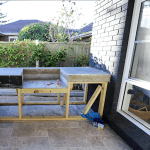
Choosing & Preparing Outdoor Surfaces for Microcement
There are some specific conditions that need to be met, before microcement is used on outdoor surfaces.
The guide below explains more about when you can (& can’t) use microcement on external substrates.
Prep for Outdoor Surfaces
Here’s everything you need to know about preparing outdoor surfaces for microcement.
No Water to Underside
Microne & Microne Plus work great outdoors as long as no water can get to the underside of the microcement. Because the microcements are waterproof, they don’t allow moisture to penetrate through them, meaning moisture will build up on the underside & can cause a problem over time.
As long as the outdoor surface is waterproofed (with a damp proof membrane or similar) or above ground level & the external edges of the microcement are siliconed so not water can get behind it, then you can apply it on outdoor patios.
Limitations on Ground Level Patios
We don’t generally recommend using our microcement on ground level patios, since they are constantly exposed to ground water both below and around the external edges, which is very hard to control even when a damp proof membrane is installed.
Completely Flat
Surfaces must be completely flat before microcement is applied. It will follow the contours of the substrate and can’t be used to fill large voids. Blocks and bricks will need to be rendered with concrete before microcement is applied.
Suitable for Use Outdoors
Substrates must be suitable for use outdoors, for this reason, the following materials are regularly used as substrates for microcement:
- Marine Ply
- Cement Board
- Cement Render
Cured to Less than 5% Moisture Content
If there is still moisture in the substrate, the microcement could blister or de-laminate as moisture is trapped under the surface. Surfaces that aren’t fully cured are also more likely to crack as they do so whilst curing. The moisture content can be tested with a moisture meter.
Silicone All Open Edges
Once the installation is complete, apply silicone along any open edges to prevent water getting behind the microcement.
Silicone sealants must be 100% silicone to adhere to the microcement.
Pro Tip: Use a coloured silicone that matches the microcement for a more discreet seal. Mapei offer a good selection of 100% silicones that are available in a wide range of colours under the brand name Mapesil AC.